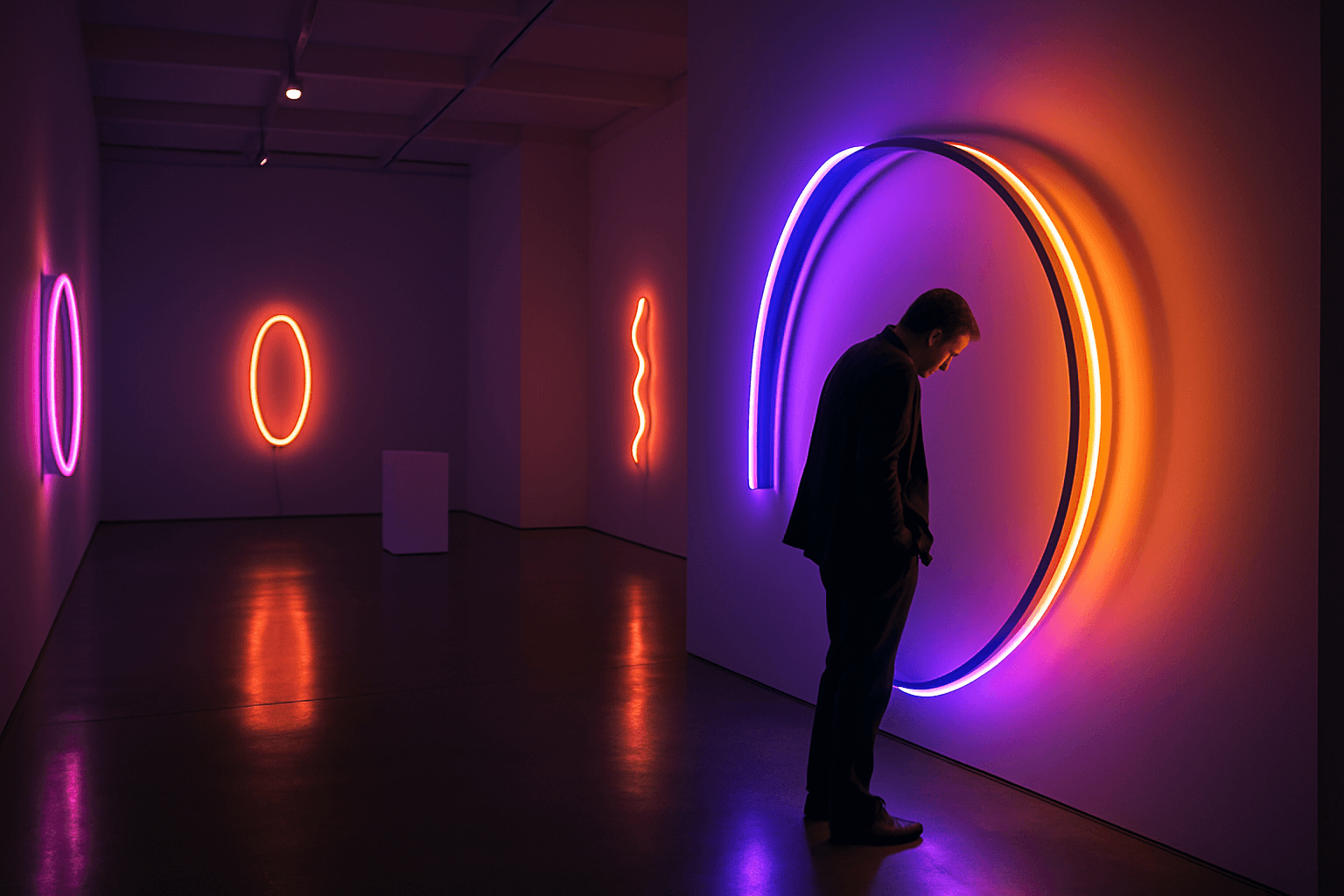
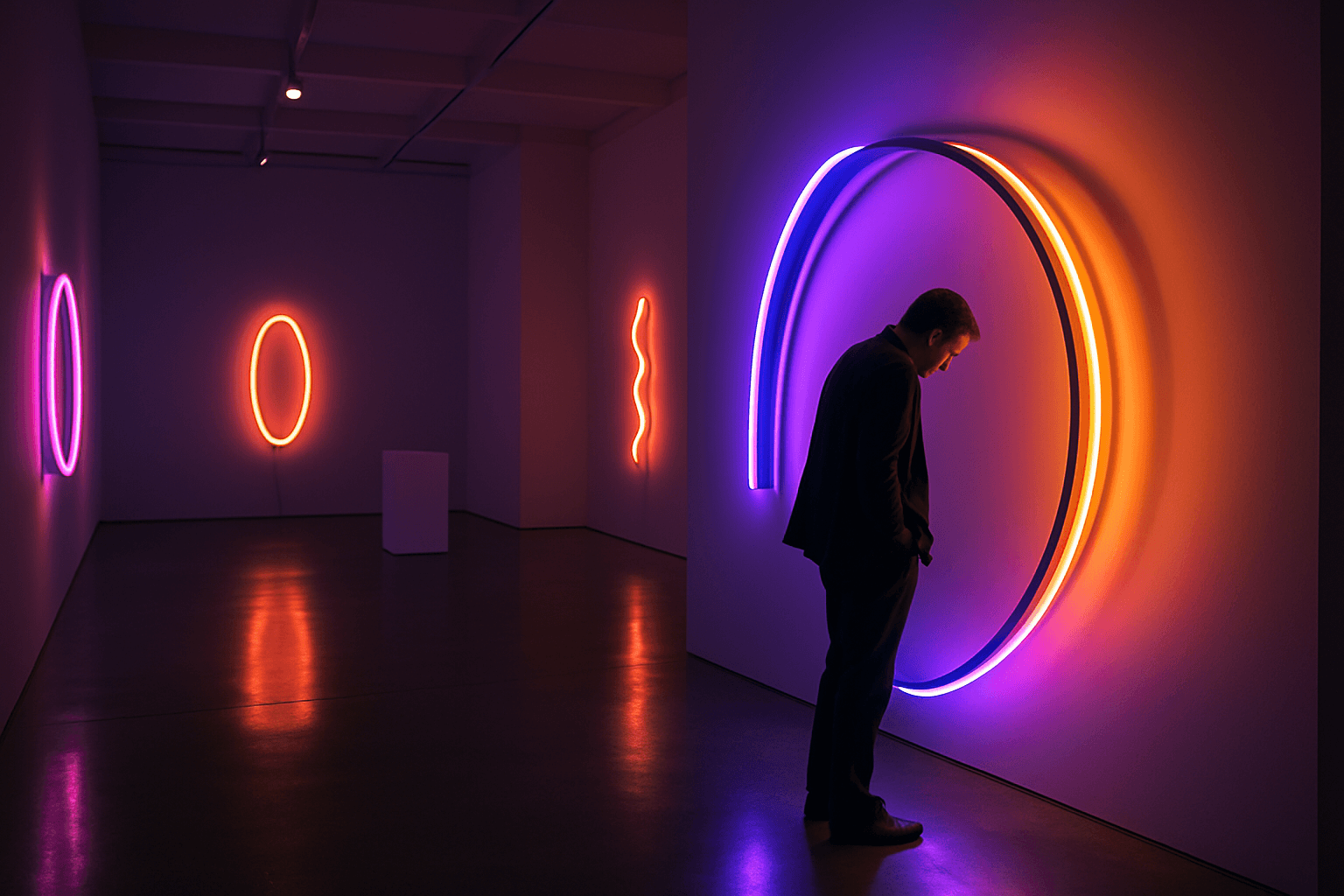
There’s a moment every serious collector knows — that split second when a work stops you mid-stride and rewires your sense of what art can be. For a growing number of collectors across South Florida and beyond, that moment is arriving in the form of light. Specifically, in the luminous curves and charged atmospheres of contemporary neon art.
Neon has completed one of the most remarkable trajectories in modern art history. What began as commercial signage — those buzzing tubes advertising diners and motels along mid-century American highways — has evolved into a medium that commands gallery walls, museum retrospectives, and six-figure auction results. The transformation didn’t happen overnight, and it didn’t happen by accident. It happened because artists recognized something collectors are now catching up to: light is one of the most powerful sculptural materials available.
If you’re considering adding neon or LED light sculpture to your collection — or if you’ve already begun and want to deepen your approach — this guide is for you.
Why Neon Art Is Commanding Collector Attention Now
The contemporary art market has been moving toward experiential and immersive work for over a decade. Collectors who once focused exclusively on painting and traditional sculpture are now seeking pieces that transform the spatial dynamics of a room — works that don’t just hang on a wall but actively alter the environment around them.
Neon art does this by its very nature. A neon sculpture doesn’t reflect light; it generates it. It fills a space with color, casts shadows that shift with the viewer’s position, and creates an atmospheric envelope that changes depending on ambient conditions. In the language of contemporary art theory, neon operates simultaneously as object, installation, and environment. That multi-dimensional quality is precisely what makes it attractive to sophisticated collectors.
The market data supports the trend. Major auction houses including Christie’s and Phillips have seen steady increases in hammer prices for works by established neon artists. Dan Flavin’s fluorescent light installations — among the earliest canonical examples of light as fine art — continue to appreciate. Tracey Emin’s neon text works regularly sell above estimate. And a newer generation of artists working in LED and neon is building critical momentum that translates directly to collector interest.
In South Florida, the conditions are especially favorable. The region’s robust gallery infrastructure, proximity to Art Basel Miami Beach, and a collector base that values bold contemporary work have created fertile ground for light-based art to thrive.
Understanding the Medium: Traditional Neon vs. LED Neon
Before building a collection, it’s essential to understand the material distinctions within light art. The term “neon” is used broadly, but the medium encompasses several distinct technologies, each with different aesthetic qualities, conservation requirements, and market positioning.
Traditional glass neon involves hand-bent glass tubes filled with noble gases — neon (which produces red-orange) or argon with mercury vapor (which, combined with phosphor coatings, produces nearly any color). This is the heritage craft, and works in traditional neon carry the aura of artisanal making. The glass is fragile, the fabrication is specialized, and the resulting pieces have a warmth and organic quality that digital alternatives struggle to replicate. For collectors, traditional neon pieces often carry higher valuations due to the skill involved and the finite lifespan of the tubes.
LED neon uses flexible silicone or PVC tubing embedded with light-emitting diodes. The technology has matured dramatically, and contemporary LED neon achieves color fidelity and brightness that rival traditional glass. LED pieces are more durable, energy-efficient, and versatile in terms of programmable effects — fading, color-shifting, responsive behaviors. Many contemporary artists prefer LED for its creative flexibility and its capacity for large-scale installation work.
Hybrid and mixed-media approaches combine neon or LED elements with other materials — steel armatures, found objects, cast resin, mirrors, video. These works position light as one element within a broader sculptural vocabulary and represent some of the most critically interesting work being produced today.
At Lux Neon Art Gallery in Dania Beach, our exhibitions encompass all three categories, and our curatorial team can help collectors understand which approaches align with their aesthetic sensibilities and collection goals.
Five Principles for Building a Neon Art Collection
1. Prioritize Artistic Intent Over Decoration
The most common mistake new collectors make with neon art is approaching it as décor rather than fine art. The distinction matters — both aesthetically and financially.
Decorative neon signs — however beautiful — are commercial products designed to enhance a space. Fine art neon is created within an artistic practice, grounded in conceptual intent, and positioned within the broader discourse of contemporary art. The difference isn’t always visible at first glance, but it’s everything when it comes to long-term value, institutional recognition, and critical relevance.
When evaluating a neon work, ask: Does this artist have a sustained practice? Is there a body of work that this piece belongs to? Has the work been exhibited in curated contexts? These questions separate investment-grade art from attractive lighting.
2. Understand Provenance and Documentation
Light art presents unique provenance challenges. Because neon tubes have finite lifespans (traditional neon typically lasts 8–15 years before re-gassing or tube replacement is needed), the question of authenticity becomes more nuanced than with static media.
Reputable galleries and artists provide certificates of authenticity that address the medium’s specificity — documenting not just the work’s creation but the parameters for acceptable restoration and component replacement. Some artists, following the model established by Flavin and others, specify that their works can be re-fabricated according to documented specifications, with authenticity residing in the concept and certificate rather than the original physical components.
When acquiring neon art, ensure you receive comprehensive documentation: certificate of authenticity, fabrication specifications, installation diagrams, maintenance instructions, and the artist’s stated policy on component replacement. At Lux Neon Art Gallery, every acquisition includes full documentation and ongoing conservation guidance.
3. Consider Conservation From the Start
Light art requires conservation planning that differs fundamentally from traditional media. You won’t be worrying about UV damage to pigments — the work is light. Instead, the conservation concerns are electrical, structural, and environmental.
Key considerations include:
- Electrical infrastructure: Ensure your space can support the work’s power requirements. Some large-scale neon installations require dedicated circuits.
- Climate control: Traditional glass neon is sensitive to temperature extremes and humidity fluctuations. South Florida’s climate demands climate-controlled display environments.
- Component aging: Transformers, LED drivers, and gas tubes all have lifecycles. A conservation plan should anticipate replacement schedules and budget accordingly.
- Light degradation: Over time, phosphor coatings in traditional neon can shift color. LED components dim at predictable rates. Understanding these timelines helps collectors plan for professional maintenance.
The good news: with proper care, neon art is remarkably enduring. Many Flavin installations from the 1960s remain in active museum display, maintained according to the artist’s specifications. A well-documented, well-maintained neon work can last generations.
4. Explore Emerging Artists — The Value Horizon
While established names in light art command premium prices, the most exciting collecting opportunities often lie with emerging and mid-career artists. South Florida, with its dynamic creative ecosystem, is producing exceptional talent in the light art space.
Emerging artists working with neon and LED are exploring territory that established artists haven’t reached — integrating responsive technology, incorporating biological and environmental data into light behaviors, and pushing the boundaries of scale and site-specificity. Acquiring work from these artists early represents both an aesthetic opportunity and a potential financial one.
Lux Neon Art Gallery actively scouts and exhibits emerging neon artists from South Florida, Latin America, and the broader international scene. Our curatorial programming is designed to introduce collectors to the next generation of significant voices in light-based art.
5. Think Spatially, Not Just Visually
Neon art exists in space differently than any other medium. A painting relates to the wall it hangs on. A sculpture occupies a defined volume. But a neon work radiates — it colonizes the space around it with color and atmosphere. When collecting neon art, you’re not just acquiring an object; you’re acquiring an environmental transformation.
This means collecting neon art requires thinking about your spaces. Which rooms can accommodate the atmospheric shift a neon work creates? How will the piece interact with natural light during the day and dominate the space at night? Will multiple neon works in proximity create color interference, or can they be curated into a complementary dialogue?
The most successful neon art collections are those where the collector has thought holistically about the relationship between work and environment. At our Dania Beach gallery, we offer in-home and on-site consultations to help collectors envision how specific pieces will transform their spaces — a service that extends to residential collectors, corporate collections, and hospitality projects throughout Fort Lauderdale, Miami, and Broward County.
The South Florida Advantage
Collecting neon art in South Florida carries distinct advantages. The region’s position as a global art hub — anchored by Art Basel Miami Beach, the Pérez Art Museum Miami, the NSU Art Museum in Fort Lauderdale, and a constellation of galleries and project spaces — means collectors have access to exceptional work and deep institutional knowledge.
The climate also plays an unexpected role. South Florida’s relationship with light — the dramatic sunsets, the luminous quality of the air, the interplay between tropical foliage and golden-hour glow — creates a natural context for light-based art that few other regions can match. Neon art feels at home here in a way it doesn’t everywhere. Collectors in Dania Beach, Fort Lauderdale, Hollywood, and across Broward County are discovering that neon works resonate with the visual culture of the region itself.
And the collector community here is sophisticated, adventurous, and growing. The conversations happening in South Florida about light art, immersive installation, and the boundaries between art and architecture are among the most vital in the contemporary art world.
Begin — Or Deepen — Your Collection at Lux Neon Art Gallery
Whether you’re acquiring your first neon work or expanding an established collection, Lux Neon Art Gallery in Dania Beach is your resource. Our gallery programming features curated exhibitions of contemporary neon and LED light art, and our team offers personalized collecting guidance — from artist introductions and studio visits to conservation planning and installation support.
We also offer bespoke commissions for collectors who want to collaborate directly with artists on site-specific works. A commissioned neon installation, designed in dialogue between artist, collector, and space, represents one of the most rewarding experiences in contemporary art collecting.
Visit us at our Dania Beach gallery to explore current exhibitions and discuss your collecting goals. Call (954) 477-2768 for private viewing appointments, commission inquiries, or to schedule a collection consultation. Browse our current exhibitions and available works at luxneonartgallery.com.
The future of contemporary art is luminous. Your collection should be too.
Lux Neon Art Gallery is South Florida’s destination for contemporary neon and LED fine art, curated exhibitions, and bespoke light art commissions. Located in Dania Beach, FL, we serve collectors, designers, and institutions throughout Broward County, Fort Lauderdale, Miami-Dade, and the international art community.